Independent review
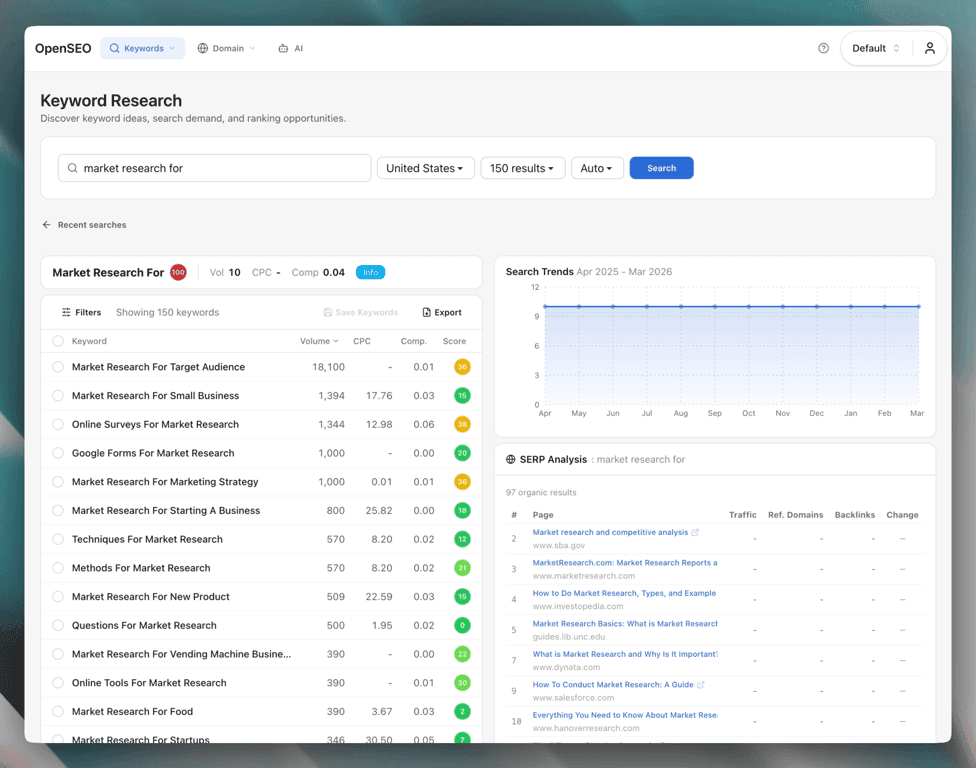
Assessment — OpenSEO packages keyword research, rankings, competitor and backlink analysis, audits, AI-search visibility, saved research, and agent access into one open application. It is a credible alternative interface to large SEO subscriptions, but not an independent SEO index. Most useful results come from the metered DataForSEO API, so self-hosting changes control of the application and workflow without eliminating external data cost or provider limits.
The local Docker route is unusually accessible: copy the environment template, add the required DataForSEO credential, start Compose, and open the loopback-bound service. That ease has a crucial boundary. Docker mode uses local_noauth and creates a local administrator, so the official guide says not to expose it directly; use an authenticated proxy, private network, or tunnel. The Cloudflare route supports a more deliberate hosted shape but adds Access, D1, R2, multiple KV namespaces, Workflows, Durable Objects, secrets, and binding administration.
Setup difficulty — easy to moderate for a private local Docker deployment and moderate to advanced for an Internet-facing Cloudflare deployment. Google Search Console needs Google OAuth and application auth secrets, while the in-app AI path can require OpenRouter. Anonymous self-host telemetry is documented and can be disabled. Cloudflare operators also need an R2 lifecycle policy if they do not want cached provider responses to grow indefinitely.
OpenSEO fits technical marketers, solo operators, and small engineering-led growth teams that prefer a focused workflow and usage-based data economics. It is less suitable for teams expecting bundled proprietary indexes, enterprise support, or a public Docker endpoint with built-in multi-user authentication. Semrush and Ahrefs are the direct category alternatives named by the project, but their subscription bundles and data ownership make cost comparisons workload-dependent.
GitHub reports main active, enabled, unarchived, and MIT licensed. The reviewed HEAD was committed in July 2026, and v0.1.1 had just fixed the Cloudflare self-host path. An early version number is not evidence of failure, but it supports conservative adoption: pin the image instead of latest, cap provider spend, back up local state, disable or document telemetry, and rehearse upgrades before relying on it for recurring client work.
Practical fit
Best for technical operators who accept DataForSEO usage costs and can keep local_noauth private or configure Cloudflare Access; it does not include its own global SEO data index.
Useful for
Keyword, SERP, domain, competitor, backlink, and site-audit research Rank tracking and Google Search Console analysis MCP-based SEO research for compatible AI agents
Dependencies
Docker Compose for local self-hosting or Cloudflare Worker infrastructure Node.js 20+ and pnpm for development Local Wrangler state or Cloudflare D1, R2, KV, Workflows, and Durable Objects
External services
DataForSEO API is required for core SEO data Optional Google OAuth and Google Search Console Optional OpenRouter for in-app AI workflows Cloudflare services for the represented hosted deployment
Deployment notes
Bind Docker mode privately and place any remote access behind authentication; it intentionally has no app auth. Pin a concrete image, persist Wrangler state, set DataForSEO spend controls, decide whether to disable telemetry, and configure R2 lifecycle cleanup when using Cloudflare.
Limitations
Core data remains dependent on the paid external DataForSEO API. The default Docker mode has no application authentication and must not be exposed directly. Anonymous telemetry is enabled unless an opt-out variable is set. The Cloudflare path introduces several provider-specific resources and cache lifecycle work.
Project media